Montessori Program for Ages 2–6 in Elmhurst, IL Authentic Montessori,
Thoughtfully Modern

Pre‑Primary (2–3) and Primary (3–6) classrooms follow the five classic areas — Practical Life, Sensorial, Language, Math, Cultural — in mixed‑age environments that cultivate independence, concentration, and joy.

Ages 2–6 Mixed-Age Communities 3-Hour Work Cycle Full-Day Mandarin Immersion 5 Curriculum Areas
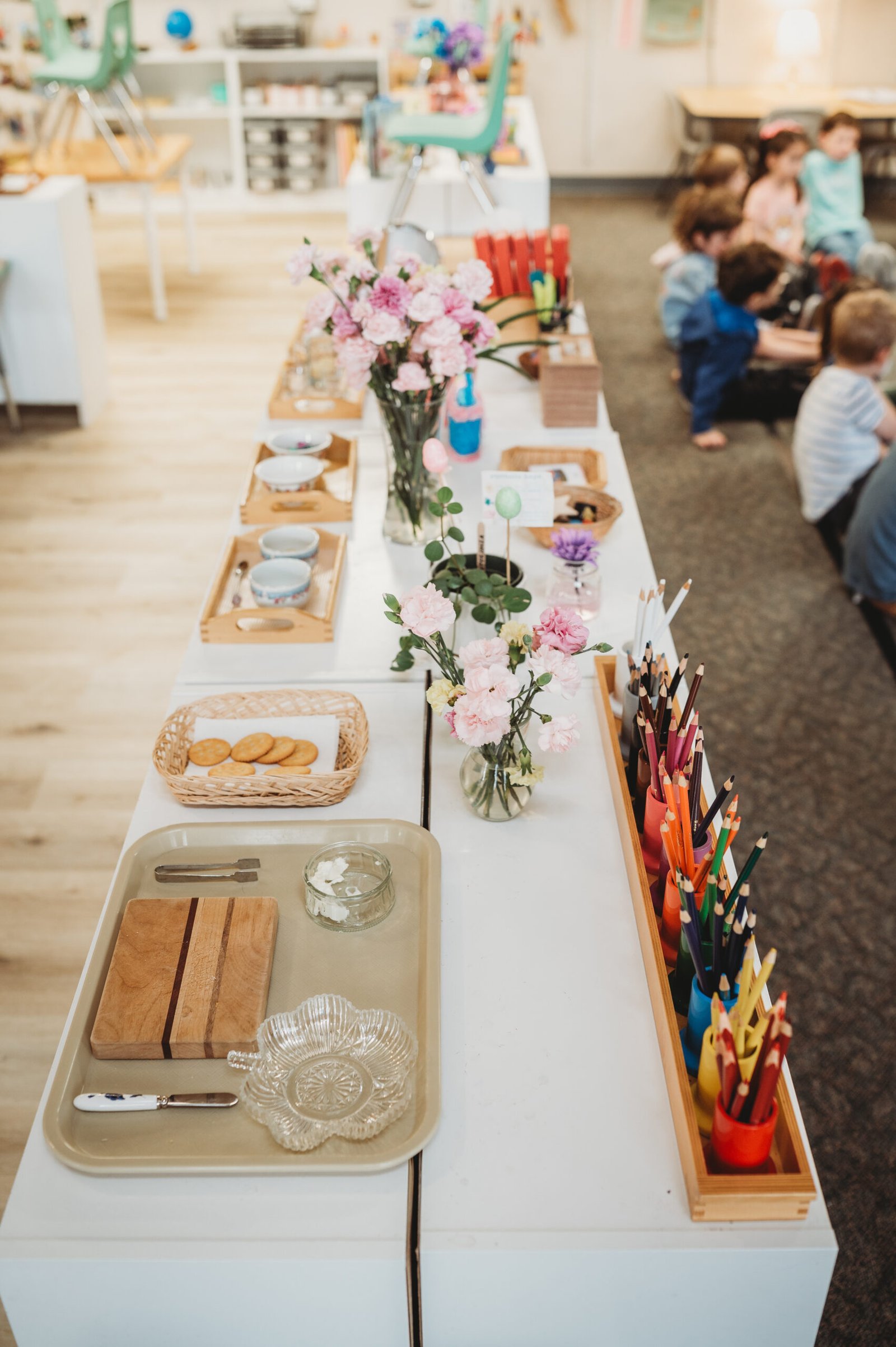
Montessori classroom at W Montessori Academy in Elmhurst, Illinois, with children working at child-sized tables W Montessori Academy · Elmhurst, IL
3hrs
Uninterrupted Work Cycle
5
Core Curriculum Areas
2–6
Ages Served
Mixed
Age
Community Model
3hrs
Uninterrupted Work Cycle
Primary program daily
5
Core Curriculum Areas
concrete to abstract
2–6
Age Range Served
Pre-Primary & Primary
3rd
Year: Kindergarten Leadership
within the Primary cycle

Traditional Montessori,
Integrated with Today's Best Practice

Children work through sequenced materials at their own pace during an extended, uninterrupted work cycle. Guides present precise lessons, then step back so children can repeat, refine, and internalize skills independently.

Our Approach

How Montessori Works

  • Mixed‑age communities encourage leadership and empathy.
  • Hands‑on materials move from concrete to abstract understanding.
  • Calm, beautiful spaces promote focus and intrinsic motivation.
We honor the core of Montessori while integrating gentle updates — language‑rich dialogue, full-day Mandarin immersion in the Primary program, early executive‑function supports, and thoughtful enrichment — so every child is ready for today's world.
Prepared Environment

Safety, Authenticity & Respect

All materials are authentic Montessori tools and age‑appropriate. Classrooms are arranged for purposeful movement, with child‑sized furnishings, open shelves, and carefully curated work choices that support independence.

Low student‑to‑teacher ratios
Daily outdoor time (weather permitting)
Grace & Courtesy embedded in all routines

Pre‑Primary & Primary

Two distinct programs, one continuous philosophy. Each age band builds on the last — laying foundations in Pre‑Primary that Primary children extend into fluent abstraction and leadership.

Pre‑Primary · Toddler · Ages 2–3

Building Independence & Coordination

Early Practical Life builds care‑for‑self and care‑for‑environment (buttoning, pouring, plant care). Sensorial work refines sight, touch, hearing, and introduces classification. Language blossoms through phonetic games and rich vocabulary; Math begins with quantity and sequence; Cultural opens nature and community awareness.

Uninterrupted work cycle: ~120 minutes
Toilet learning supported respectfully
Grace & Courtesy: language for collaboration
Half-day or full-day, 4 or 5 days per week
Primary · Preschool & Pre-K · Ages 3–6

From Concrete Mastery to Abstraction

Children extend to multi‑step Practical Life, advanced Sensorial (grading, series), phonetic reading/writing, Math operations and place value, and rich Cultural studies (geography, science, history, arts). Leadership grows as older children model and mentor.

Extended work cycle: 150–180 minutes
Full-day Mandarin immersion — woven through the whole day, not a single class period
Small‑group key lessons daily
Kindergarten leadership year within the Primary cycle

Schedules & Tuition

Both programs run as a half-day (8:30–11:30 AM) or full-day (8:30 AM–3:30 PM) schedule, four or five days per week. Monthly tuition ranges from $885 to $1,950.

See Full Tuition Table

Five Core Areas

Each area progresses from concrete exploration to abstract understanding — every material carefully sequenced to build the next, creating a complete and interconnected learning environment.

Practical Life — Coordination, Concentration, Independence, Order

Activities include spooning, pouring, transfer work, food prep, dressing frames, sweeping, and care of plants/animals. Children practice sequencing, control of movement, and responsibility.

  • Pre‑Primary: simple transfer, large‑muscle control, self‑care habits.
  • Primary: multi‑step processes, grace & courtesy leadership, real contribution to the community.
Sensorial — Refinement of the senses

Materials isolate qualities (size, shape, color, texture, temperature, sound, weight) to develop perception and classification, building the bridge to math and language.

  • Pre‑Primary: simple matching and sorting.
  • Primary: grading, seriating, and vocabulary for properties.
Language — Spoken, written, and reading

Rich conversation, storytelling, sound games, sandpaper letters, movable alphabet, and early readers support phonemic awareness to fluent reading and expressive writing. Primary children are immersed in Mandarin throughout the day alongside their English language work, and the afternoon World Language period adds Spanish or Polish.

  • Pre‑Primary: vocabulary expansion, phonetic awareness.
  • Primary: encoding/decoding, function of words, handwriting, full-day Mandarin immersion.
Math — Concrete to abstract numeracy

Number rods, spindle boxes, bead chains, golden beads and stamp game make numeration, quantity, and operations tangible, leading to place value and problem‑solving.

  • Pre‑Primary: 0–10 quantities and numerals.
  • Primary: operations (±×÷), place value, skip counting and patterns.
Cultural — Geography, science, arts & history

Children explore continents, land/water forms, botany/zoology, simple experiments, timelines, songs and art from around the world to develop global perspective and curiosity.

  • Pre‑Primary: nature study, community helpers.
  • Primary: map work, classification, life cycles, early research.

A Day in Montessori

Morning features the uninterrupted work cycle (Primary ~3 hrs · Pre‑Primary ~2 hrs). Line Time closes the morning as a whole community practice of grace and joy. Afternoons include outdoor play, lunch, enrichment, rest/quiet work, World Language, and dismissal. Mandarin is not a scheduled period — it runs as immersion across the entire Primary day.

Primary · Ages 3–6

Detailed Daily Schedule

All DayMandarin immersion runs across every block below — it is part of classroom life, not a scheduled period.
Primary program daily schedule, ages 3 to 6, W Montessori Academy Elmhurst
TimeExperienceNotes
8:15–8:30Arrival & PreparationGreet, hang belongings, choose first work
8:30–11:15Uninterrupted Work Cycle (≈3 hrs)Self‑guided work; individual/small‑group presentations; rolling snack when ready
Line TimeWalk the line, silence game, songs & movement
11:15–11:50Playground / Large MotorOutdoor gross‑motor movement
12:15–12:45Montessori LunchPlace setting; buffet; practical life cleanup
12:45–1:15Enrichment ↗Rotates weekly: Music · STEM · Karate · Culinary · Language
1:15–2:30Rest / Quiet WorkNon‑nappers: quiet works & community jobs
2:30–2:55Afternoon SnackChild‑prepared where appropriate
2:55–3:10World LanguageSpanish or Polish practice
3:10–3:30Closing & DismissalReflect, prepare environment, goodbye ritual

Half-day Primary children are dismissed 11:15–11:30 AM.

Pre‑Primary · Ages 2–3

Detailed Daily Schedule

Pre-Primary toddler program daily schedule, ages 2 to 3, W Montessori Academy Elmhurst
TimeExperienceNotes
8:15–8:30Arrival & PreparationGreet, hand‑washing, choose work
8:45–10:30Work Cycle (≈2 hrs)More together‑time for presentations & snack
Line Time (Community)Walking on the line, silence, songs
10:30–11:15Playground & Large MotorOutdoor movement
11:15–11:30LunchGrace & courtesy; practical life routines
11:30–12:00Toileting / DiapersRespectful support and readiness cues
12:00–2:30Nap / RestCalm environment; gradual wake‑up
2:30–2:45PM SnackHealthy snack; self‑service supported
2:45–3:15Classroom TimeShort works, stories & songs
3:15–3:30Closing & DismissalReflect, prepare environment, goodbye ritual

Note: Pre‑Primary keeps a bit more together‑time to build the habits that prepare children for Primary. Half-day children are dismissed 11:15–11:30 AM.

What Children Gain

Outcomes in Montessori go far beyond academic content — they encompass habits of mind, social capability, and the self-direction that makes a child ready for any environment ahead.

Pre‑Primary Outcomes

Readiness & Self‑Care

  • Independence in dressing, toileting, and snack preparation
  • Ability to choose, complete, and return work materials
  • Emerging phonemic awareness and number sense (0–10)
  • Grace & Courtesy language for collaboration and turn‑taking
Primary Outcomes

Academic & Social Leadership

  • Fluent sound–symbol connection; early reading and writing
  • Concrete understanding of operations and place value
  • Early Mandarin listening and speaking built through full-day immersion
  • Research habits through Cultural studies and projects
  • Executive functions: planning, persistence, care of environment

Observation & Communication

We believe families are essential partners in a child's Montessori journey. Transparent communication, ongoing documentation, and mutual respect form the foundation of everything we do together.

Observation & Assessment

Ongoing, Child‑Centered Documentation

Guides observe daily and track progress across scope‑and‑sequence for each area. Conferences share strengths, next steps, and how families can extend learning at home.

Daily scope-and-sequence tracking

Continuous observation across all five areas by classroom guides.

Twice-yearly conferences

In-depth family meetings sharing strengths, growth areas, and at-home extension ideas.

Family Partnership

Transparent Communication

Classroom snapshots, in and out of school events as well as parent education keep families connected to their child's growth. Parents receive updates during conferences, and Directresses are always available for conversations when needed.

This approach respects the child's independence and avoids daily reports that can interrupt the child's space.

Frequently Asked Questions

Have a question not answered here? Schedule a tour — most families find the answer becomes clear the moment they observe the classroom in action.

Is Montessori right for my child?

Montessori supports a wide range of learners by matching lessons to readiness and offering freedom within limits. We encourage a tour to see the fit firsthand.

How are mixed-age Montessori classrooms managed?

Older children model and lead; younger children observe and aspire. Guides give small‑group lessons tailored to each child's level — the mixed age range is a feature, not a challenge.

What happens during the kindergarten year?

The third year of the Primary cycle, the kindergarten year, is a leadership year. Previous concrete work becomes fluent abstraction and children take on a genuine mentoring role with younger classmates.

How is Mandarin taught?

Mandarin runs as full-day immersion in the Primary program, ages 3 to 6. It is not a scheduled class period — children hear and use Mandarin throughout the day as part of classroom life. This makes us one of the few Montessori schools in DuPage County offering preschool-level Mandarin immersion. Separately, the afternoon World Language period introduces Spanish or Polish.

What are the schedule options?

Both Pre‑Primary and Primary are available as a half-day program running 8:30–11:30 AM, or a full-day program running 8:30 AM–3:30 PM, four or five days per week. See the full tuition table.

How do you support a child's transition into the classroom?

We offer gentle orientation, consistent routines, and close communication with families to ensure a confident, calm start — for both child and parent.

Visit Our Classrooms

Schedule a tour to experience Montessori in action and meet our guides. Nothing explains it better than seeing it live.

Or call (630) 279-5300 · 136 W Vallette St, Ste 8, Elmhurst, IL 60126